
VHP is used to treat environments where microbial contamination compromises product quality, patient safety or the reliability of testing. Each sector applies VHP to different spaces, equipment and cycle frequencies. This article describes VHP applications in pharmaceuticals, hospitals and laboratories, the situations that trigger a cycle, and the choice between outsourced decontamination services and in-house equipment.
Applications in the pharmaceutical industry
The pharmaceutical industry uses VHP in areas where product sterility is essential for batch release.
Isolators and RABS
Isolators and restricted access barrier systems undergo VHP cycles at a frequency defined by site procedures, particularly between certain production campaigns or when changing products. The cycle destroys spores present on internal surfaces and filling equipment. The generator connects to the isolator to automate the sequence.
Cleanrooms and classified areas
High-grade cleanrooms undergo VHP cycles during scheduled shutdowns. The cycle complements routine manual cleaning and disinfection without replacing them.
Transfer airlocks and pass-through chambers
Transfer airlocks allow materials to enter aseptic areas. A VHP cycle decontaminates the external surfaces of materials as they enter, helping to protect the critical area.
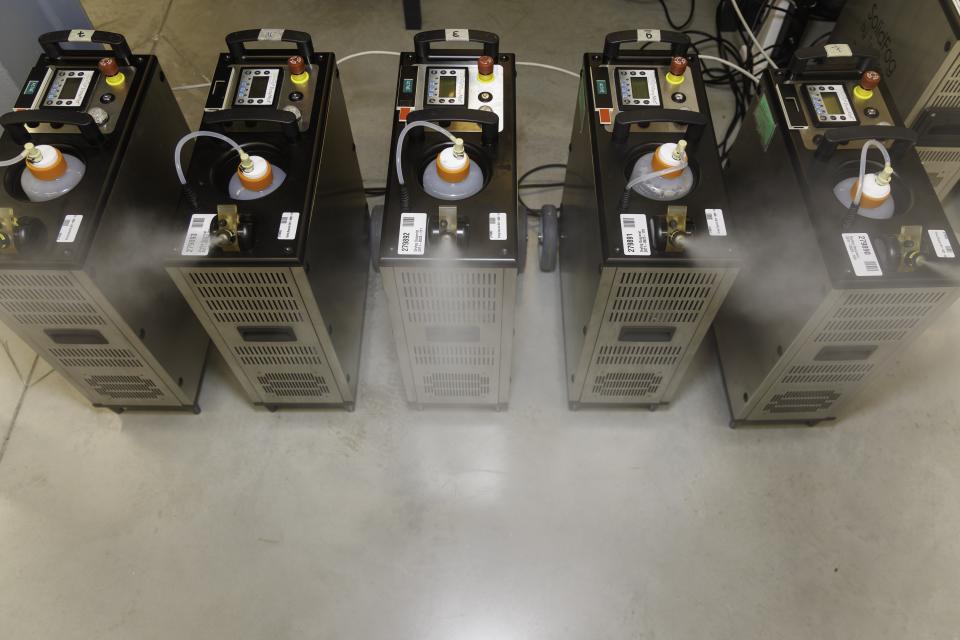
Example of a biodecontamination sequence in a pharmaceutical isolator
A typical isolator biodecontamination sequence follows five steps:
-
Preparing the isolator at the end of the production campaign
-
Closing the isolator and checking its configuration
-
Starting the VHP cycle from the control interface
-
Aeration and neutralization until the defined re-entry threshold is reached
-
Recording the cycle and releasing the isolator for the next production campaign
This sequence is performed according to the biodecontamination procedures established by the site. It is not systematically repeated at every batch change: its frequency depends in particular on the manufacturing process, risk assessment and contamination control strategy. An automated cycle reduces downtime and limits the number of human interventions in the critical area.
Applications in hospitals
Hospitals use VHP to treat areas where the risk of infection remains high:
-
Isolation rooms for patients carrying high-risk microorganisms
-
Operating rooms
-
Critical care units
-
Hospital pharmacies and their preparation isolators
The room remains closed and unoccupied throughout the cycle, requiring coordination with healthcare departments. Room mapping and the placement of biological indicators document cycle efficacy, as in the pharmaceutical industry.
Applications in laboratories
Laboratories use VHP to treat enclosures and rooms where biological risk control is a priority:
-
Microbiology and quality control laboratories
-
Biological safety cabinets during maintenance or filter replacement
-
Animal facilities and areas housing animal models
-
Research laboratories handling pathogens
-
Cell and gene therapy facilities
Organizing a VHP cycle in a hospital department
A hospital VHP cycle requires coordination between several teams. Five steps structure the process:
-
Scheduling the cycle with the infection prevention and control team and technical services
-
Securing the room with appropriate signage and restricting access
-
Placing biological indicators at locations defined during room mapping
-
Starting and monitoring the cycle from outside the room
-
Removing access restrictions once the concentration has fallen below the exposure threshold
This organization reduces room downtime and protects healthcare personnel.
Situations that trigger a VHP cycle
A site may schedule a VHP cycle in seven typical situations:
-
The end of a production campaign or a product change
-
Maintenance work requiring access to a critical area
-
A microbiological monitoring deviation in a cleanroom
-
The discharge of a patient carrying a high-risk microorganism
-
An outbreak in a healthcare unit
-
Replacement of a biological safety cabinet filter
-
Periodic requalification of an area
The site documents each cycle trigger in its contamination control plan.
Cycle frequency according to the application
The frequency of VHP cycles varies depending on the application. A manufacturing isolator undergoes cycles at a frequency defined by site procedures, which may include biodecontamination between certain production campaigns or when changing products, without necessarily requiring a cycle at every batch change. A cleanroom undergoes a cycle at intervals defined by the contamination control plan and following a deviation. A hospital room undergoes a cycle as needed, following the discharge of a high-risk patient. A laboratory adapts the frequency according to the biological risk associated with its activities. This frequency influences the choice of generator configuration, as described in our article on how a VHP generator works.
Sector-specific challenges
Each sector has different objectives when using VHP. The pharmaceutical industry focuses on product sterility and batch release, requiring a validated and documented cycle. Hospitals prioritize rapid room availability and infection risk control, requiring short, scheduled cycles. Laboratories focus on biological containment and operator protection, requiring cycles adapted to each enclosure. These objectives explain the differences in cycle duration, frequency and documentation across the three sectors.
Outsourced services or in-house equipment
A site performing only a few cycles per year often chooses an outsourced decontamination service. A service provider supplies the equipment, performs the cycle and provides a decontamination report. A site performing frequent cycles generally chooses its own equipment, reducing the cost per cycle and dependence on a third party. Solidfog offers both approaches: the sale of DosyMist® systems and a turnkey decontamination service. The team also provides consultancy, maintenance and calibration services.