
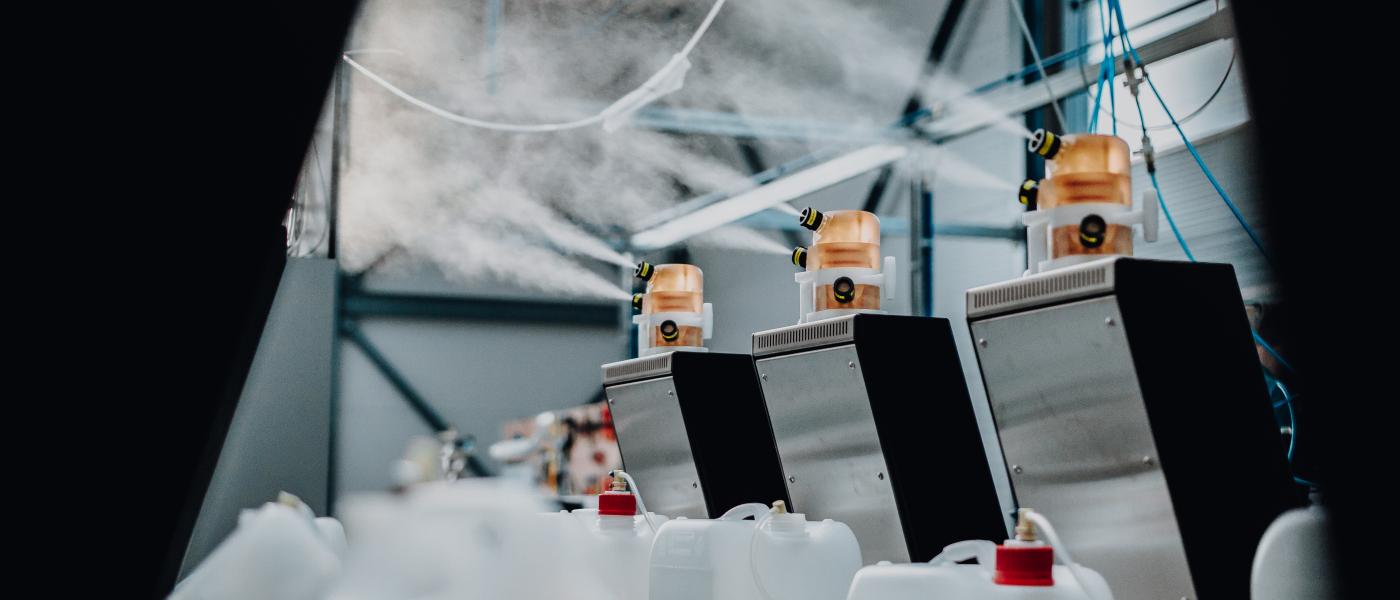
Solidfog applies a structured approach to the development and validation of airborne surface disinfection (ASD) processes using hydrogen peroxide (VH₂O₂).
Each project begins with a detailed analysis of the site conditions and ends with a fully validated, traceable, and reproducible decontamination cycle compliant with EN 17272 and GMP requirements.
Through this methodology, we deliver VH₂O₂ decontamination cycles that are scientifically validated, operationally robust, and fully compliant with GMP standards. Every parameter is controlled, every result is reproducible, and every cycle is built on 6-log certainty.
Key parameters of a decontamination cycle in a controlled environment
A well-designed VH₂O₂ biodecontamination process can operate effectively under standard environmental conditions without a preconditioning phase. Studies have demonstrated that relative humidity levels between 40% and 70% and temperatures between 17 °C and 27 °C can achieve a validated 6-log microbial reduction, provided that the initial H₂O₂ concentration is properly adjusted.
Solidfog typically recommends a 12% H₂O₂ dilution, which provides the optimal balance between sporicidal efficacy and material compatibility. For this concentration, the ideal starting conditions are 20 °C and 40% relative humidity, although other starting points can be validated depending on the room volume, surface characteristics, and geometry of the treated area.
In some cases, microbiologists report that higher humidity levels favour increased micro-condensation, improving sporicidal activity for specific microorganisms.
For this reason, Solidfog always performs a case-by-case cycle development, adapting the parameters to the environment and validating performance through structured trials.
Solidfog methodology for developing a decontamination solution
1. Data collection and analysis of decontamination conditions
The process starts with the collection of detailed environmental and operational data, including:
- Cleanroom architecture and layout, with identification of equipment, furniture, and internal obstructions.
- Total room volume and geometric characteristics.
- Definition of connected areas sharing a common air handling unit (AHU) that must be decontaminated simultaneously.
- HVAC system design and performance, including air change rates (ACH) and air renewal capacity.
- Frequency of decontamination cycles per area and expected cycle lead times.
- Target log-reduction level required for validation.
- Typical environmental conditions, such as relative humidity and temperature, along with seasonal variations or extremes.
- Cleaning and disinfection procedures performed prior to VH₂O₂ decontamination, to prevent chemical incompatibility or corrosion risks.
- Identification of hot and cold spots or surface types that may negatively affect VH₂O₂ distribution or promote excessive condensation.
2. Definition of an appropriate decontamination solution
Based on the collected data, we define an initial system configuration that includes:
- Number and positioning of units, as well as the orientation of spray heads according to the room layout, airflow direction, and internal obstructions such as machinery or furniture.
- Quantity and concentration of the VH₂O₂ biocide, adjusted to the target log-reduction level and material compatibility.
- Estimated cycle phases and contact times, determined by the expected environmental conditions and the adsorption capacity of materials within the treated space.
Lead times are strongly influenced by factors such as the adsorption capacity of internal materials and filters, the concentration of H₂O₂, the room architecture, and the air renewal rate provided by the HVAC system.
3. Development and validation of the decontamination cycle
Cycle development is a systematic process that focuses on the optimisation and validation of all critical VH₂O₂ parameters to guarantee performance, reproducibility, and regulatory compliance.
The objective is to achieve a validated 6-log microbial reduction while maintaining efficient cycle times and controlled H₂O₂ consumption.
The process begins with a series of iterative trials aimed at defining the optimal biocide quantity, injection rate, pressure, and flow, as well as the position and orientation of the spray nozzles. Each trial builds upon the previous one, progressively refining the parameters to achieve uniform distribution and consistent decontamination results throughout the treated area.
The evaluation follows a defined sequence of testing. Chemical indicators are used during the initial phase to verify the homogeneity of distribution and to map the VH₂O₂ diffusion pattern. Enzymatic indicators are then introduced to assess intermediate performance and to quantify the level of microbial inactivation achieved. Final confirmation of efficacy is performed using biological indicators (BIs), which provide conclusive evidence of 6-log microbial reduction and overall process validation.
Validation is undertaken only after the development phase has demonstrated reproducible results. When inconsistencies occur, additional BI replicates (typically three per test position) are used to confirm data reliability and eliminate potential handling errors. Once consistent “no-growth” results are achieved across all positions, the cycle parameters are formally defined. These include the biocide volume, nozzle configuration, injection pressure, and flow rate, all of which are locked to ensure reproducibility in routine operation.
Every Solidfog system is equipped with integrated monitoring and data recording capabilities that automatically verify compliance with the validated parameters during each subsequent cycle. This guarantees process integrity, full traceability, and alignment with GMP and 21 CFR Part 11 requirements, ensuring that every validated cycle is both scientifically sound and operationally reliable.